

Standalone Deployment for AI Agents
Standalone deployment allows you to publish your AI Agent on a dedicated, hosted link that can be accessed independently of your website. Instead of embedding the AI Agent as a widget on a webpage, this option lets you share it as a direct destination.
This approach is particularly useful when you want users to interact with the AI Agent without any distractions from surrounding website content. The standalone link can be easily distributed across multiple channels, making it highly flexible for both external and internal use cases.
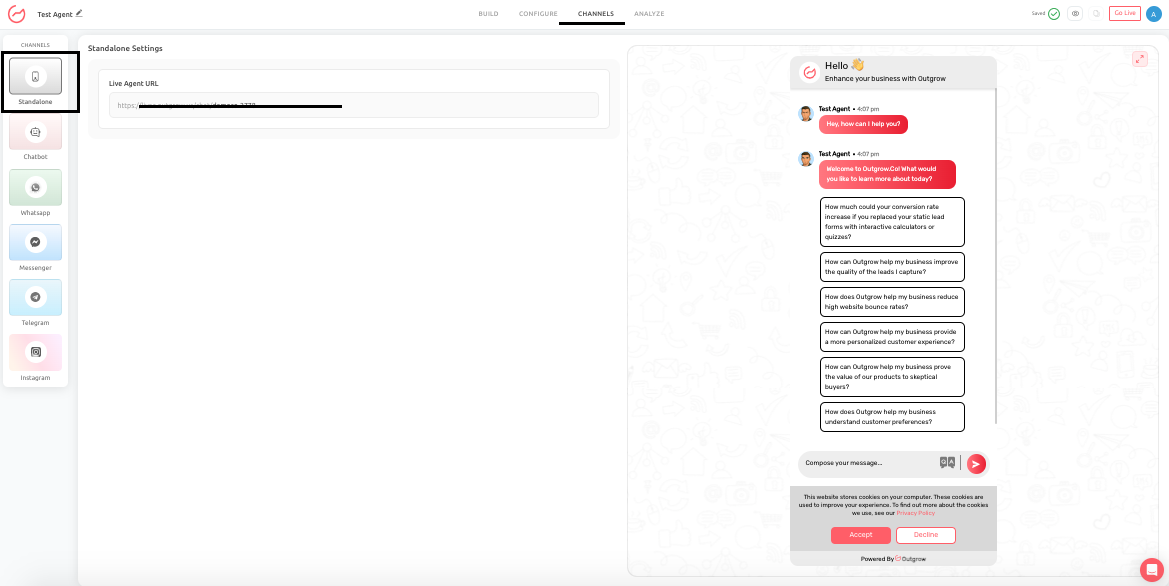
You can share your AI Agent through channels such as email campaigns, advertisements, QR codes, social media profiles, sales outreach, or internal tools.
When to Use Standalone Deployment
Standalone deployment is most effective when the AI Agent itself is the primary experience rather than a supporting feature. It is especially suitable in scenarios where:
- You want a focused interaction without website distractions
- You need to launch quickly without modifying your website
- You are running a campaign-specific or time-bound experience
- You want to distribute the AI Agent as a direct link
- The conversation flow is the main conversion path
Real Business Use Cases
- Event Registration Assistant: A conference organizer creates a standalone AI Agent to answer event-related questions, collect registration details, and provide agenda information. The link is shared via email campaigns and QR codes on promotional materials.
- Lead Qualification Funnel: A B2B company replaces a traditional landing page form with a conversational AI Agent that qualifies leads and schedules consultations. This improves engagement and reduces drop-offs compared to static forms.
- Internal Knowledge Assistant: An organization shares a standalone AI Agent with employees to answer internal queries related to processes, policies, or tools. This eliminates the need for users to navigate through multiple internal systems.
- Promotional Campaign Experience: An e-commerce brand launches a seasonal campaign using a standalone AI Agent that recommends products and shares exclusive discount codes, creating a focused and interactive promotional funnel.
Why Businesses Choose Standalone Deployment
Standalone deployment removes dependencies on website design, development, and placement decisions. It allows teams to launch faster and iterate quickly without requiring changes to existing web infrastructure.
This makes it particularly valuable for campaigns, experiments, and situations where speed and focus are critical. It also ensures that the user’s attention remains on the conversation and the intended outcome.
Best Practices To Follow
To get the most out of standalone deployment:
- Define one clear objective for the AI Agent
- Use a strong and clear welcome message
- Keep the conversation flow focused and goal-driven
- Design for mobile-first usage, since many users will access the link on mobile devices
- Ensure the call-to-action is obvious and easy to follow
Additionally, structure the conversation so users immediately understand what the AI Agent can help them achieve.
Common Mistakes To Avoid
- Treating the standalone AI Agent as a full website replacement
- Adding too many unrelated flows within a single experience
- Creating a weak or unclear introduction
- Overcomplicating the conversation with unnecessary steps
Because users land directly into the AI Agent, clarity and simplicity are essential from the very first interaction.
Conclusion
- By using standalone deployment, you can turn your AI Agent into a focused, shareable experience that operates independently of your website.
- When thoughtfully designed, it provides a streamlined, high-converting interaction that closely aligns with your business goals.
Feel free to use our chat tool on the bottom right or reach out to us at [email protected] if you have any questions, and our team can help you with a quick solution.
Updated 6 months ago